周波数同期と信号取得
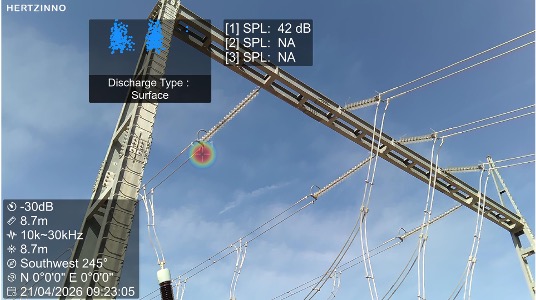
When using an acoustic camera, its PRPD detection frequency must first be set to match that of the equipment under test.
The equipment being tested is typically in operation within the power grid, and its fundamental frequencies are predominantly 60 Hz, 50 Hz, or 16.7 Hz (railway systems).
音響カメラは超音波強度の空間分布を検出し、時間と周波数にわたる音響強度信号をプロットします。中心位相の推定には、円周平均、フォンミーゼス分布、位相ヒストグラムなどの方法が使用されます。一方、PRPD パターンは最尤推定を使用して構築され、エネルギー分布の確率モデルを取得し、その後の分類またはしきい値処理に使用できる最大対数尤度値を生成します。
数学的手法: 最尤フェーズアライメント
一連の部分放電パルスが収集されたと仮定します:
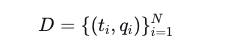
ここで:
- ti: occurrence time of the -th pulse;
- qi: amplitude, apparent charge, or energy of the -th pulse;
- N: total number of pulses.
If the power frequency is (e.g., 50 Hz), the phase corresponding to each pulse can be written as:

The key unknown quantity here Δϕ is , i.e., the phase offset.
Consider a certain class of PRPD patterns as a probability distribution P(q,ϕ), , which represents the probability of a PD pulse occurring near phase ϕ and amplitude q. Given a specific phase offset Δϕ , the joint probability of all observed pulses is:

実際には、次のことを避けるために対数が取られます。数値アンダーフロー:

最尤推定では、この対数尤度を最大化するものを求めます:

直感的な理解
PRPD パターンは位相軸に沿って連続的に周期的にシフトされます。電流パルスを基準分布に最もよく一致させるシフト角度が、最適な位相調整として採用されます。
部分放電パターンの確率的モデリング
フォン ミーゼスによる位相分布混合物
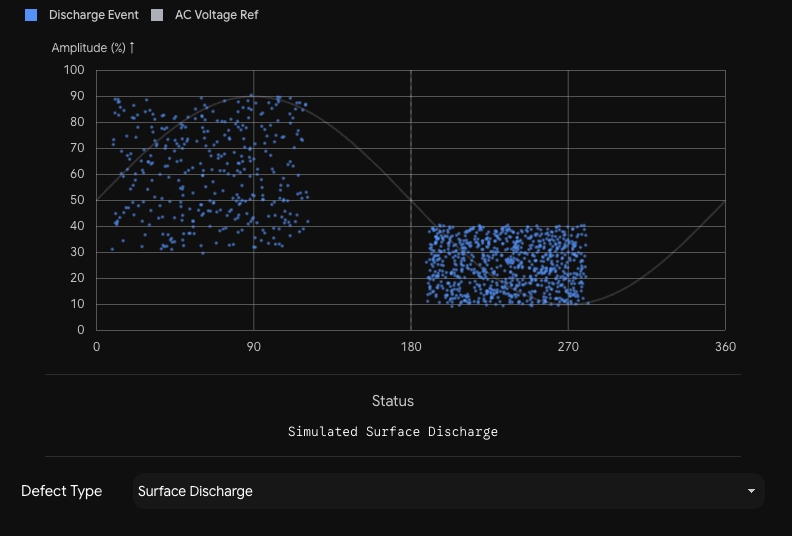
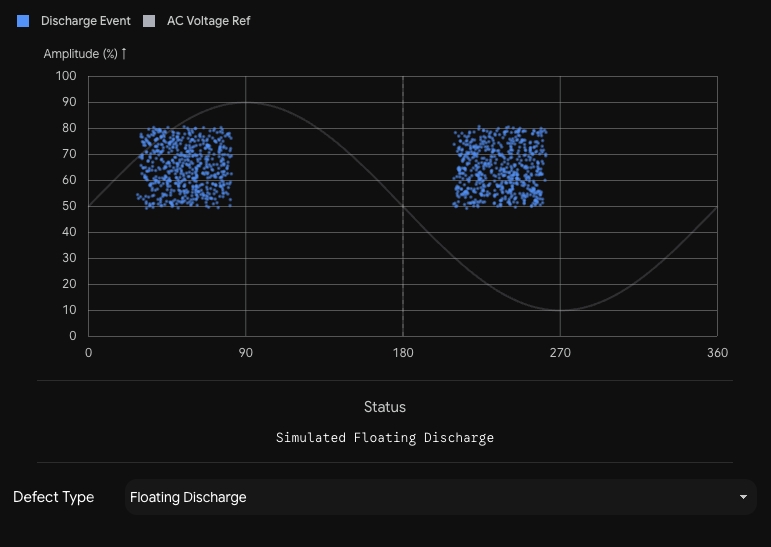
Common types of partial discharge include positive corona, negative corona, surface discharge, and floating discharge. Their discharge characteristics are well defined and typically concentrated around two phase regions, conforming to the von Mises distribution—that is, their discharge models follow a normal distribution on a circular variable.
Hence, the phase distribution can be expressed as:

ノイズ分離とクリーン エネルギー マップ
フィールド データと PRPD の 2 次元確率ヒストグラムを組み合わせることで、標準的なエネルギー分布マップを取得でき、衝撃的なノイズを効果的に除去し、測定のクリーンな分布確率を生成します。 point:

where:
- P(PD): the true PD distribution;
- Pnoise: the noise distribution;
- ϵ: the noise proportion.
Bayesian Estimation and Defect Classification
Prior Distribution
P(μ)
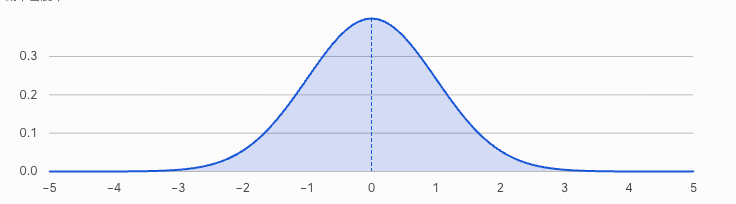
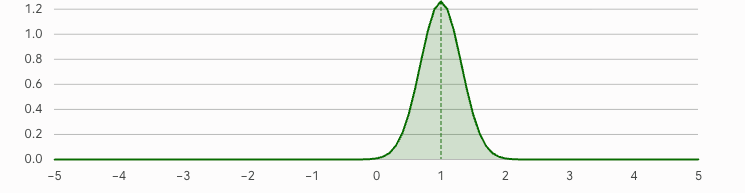
さらなる信号処理では、事前情報を使用したベイズ推定法が導入され、体系的なバイアスが低減されます。したがって、PRPD 認識アルゴリズムは、測定中の確率推定の問題になります。
Bayesian estimation is a statistical inference method. Its core concept is not to find a single fixed parameter value, but to treat the parameter to be estimated as a random variable, using a probability distribution to describe the knowledge about that parameter.
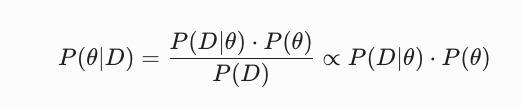
この方法は、ベイズの定理という核となる公式に依存しています。
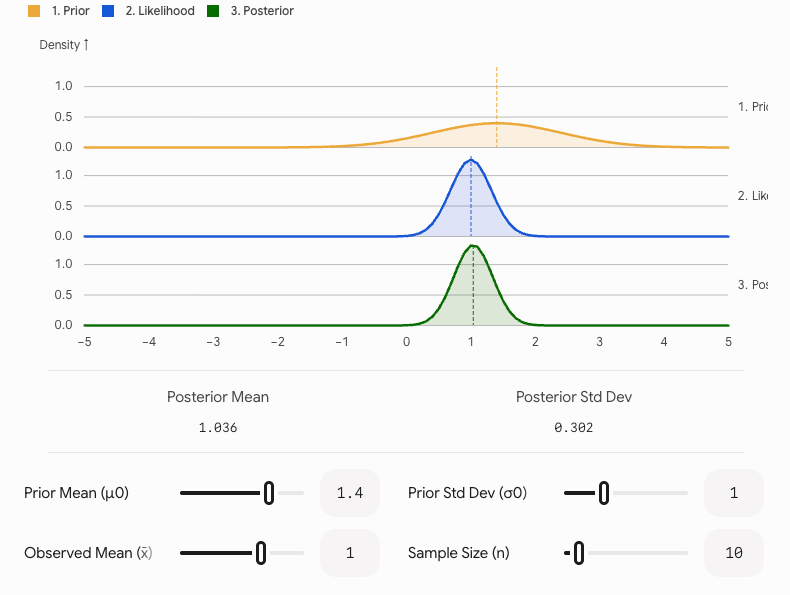
Here is the estimation visualization for a cse like observed mean as 1, prior mean as 1.4, Prior Std Dev as 1, and with a 80 samples size.
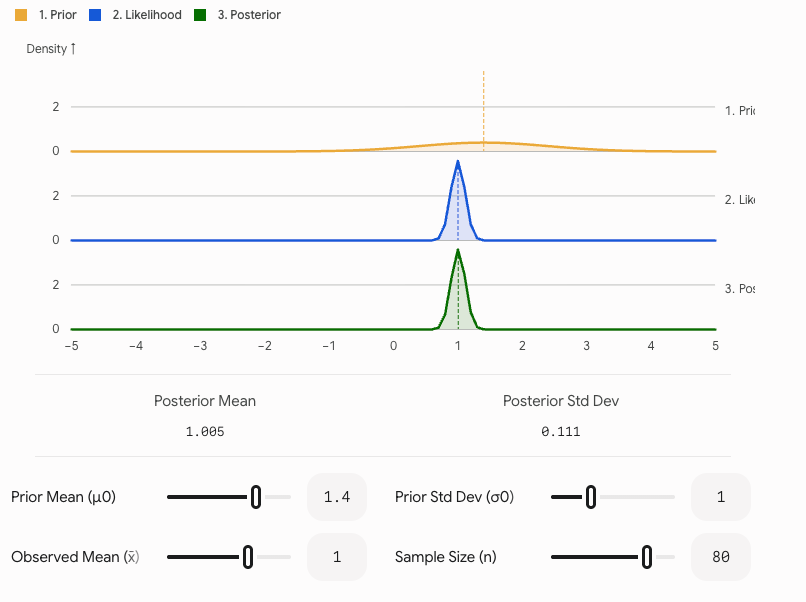
With sample numbers increase the ratio of currenction will be increased. so a circle, the camera gathering more than 50 times, so it can recognize the PRPD with a high accurrancy.
The algorithm assumes four defect categories: corona discharge, surface discharge, floating discharge, and noise (particle discharge). Each category has its own PRPD distribution, so a standard probability distribution can be used as the likelihood function for modeling, and the final detection result is obtained through Bayesian estimation.
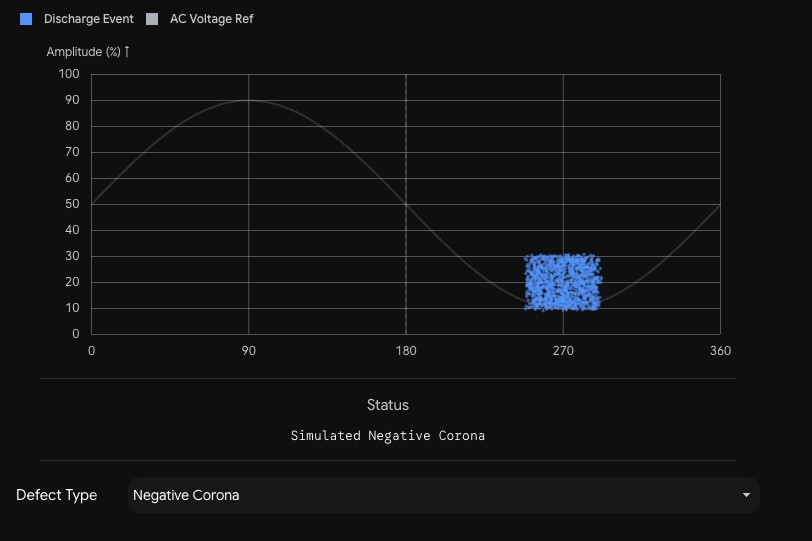
陽性コロナと陰性コロナを分離できない理由
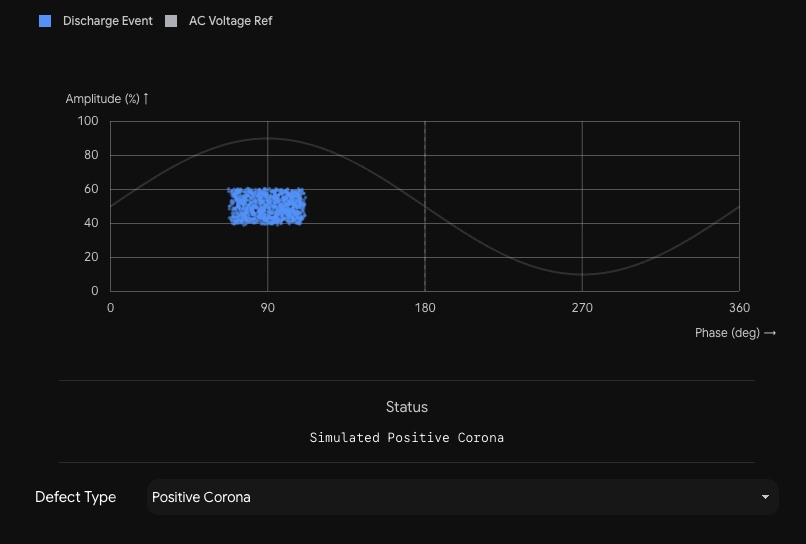
陽性コロナと陰性コロナは物理的に区別できますが、音響カメラには電圧極性基準がなく、絶対電圧ゼロクロスを決定できないことに注意してください。したがって、実際の認識アルゴリズムでは、正コロナと負コロナは単一の「コロナ放電」クラスに統合されます。これがまさに、音響カメラが陰性コロナと陽性コロナを区別できない理由です。それにもかかわらず、この統合を行っても、音響カメラはコロナ型放電の全体的な検出に関して信頼性の高い結果を提供できます。
AI ベースの堅牢なアライメントと異常の特定
To further enhance system robustness in complex field environments, artificial intelligence is introduced to handle challenges such as noise interference, multi-source discharge superposition, sensor variability, and unstable phase references. The AI model can directly output the phase offset Δϕ , a confidence score, the defect category, and an indication of whether multi-source superposition is present.
「不確実性」の保持状態
The system retains an “uncertain” state: when the PRPD pattern is too sparse, the noise level is excessively high, the defect type is unknown, or multi-source superposition is evident, the model does not force an alignment. Instead, it returns a low confidence or rejects the judgment, thereby avoiding misclassification.
位相復元のための自己教師あり学習
トレーニングフェーズでは、自己教師あり学習戦略が採用され、大規模なサンプルが自動的に構築されます。人工的なランダム循環シフト(例、、、、)が適用されます。 PRPD パターンを分析し、モデルはこのオフセットを予測する役割を果たします。これにより、手動ラベル付けなしで豊富なトレーニング データが提供され、モデルが摂動から真の位相を回復する方法を学習できるようになります。
微分可能な位相シフト層
モデル アーキテクチャの観点から見ると、微分可能な位相シフト層 (円形シフト構造に類似)空間変換ネットワーク) を組み込むことができるため、ネットワークが順方向伝播中に最適な位相変換を自動的に検索できるようになり、入力パターンが内部基準テンプレートに最もよく一致するため、エンドツーエンドの位相調整が達成されます。
位相不変分類
目的が欠陥の種類を特定することのみであり、絶対位相を回復することではない場合、位相不変の分類戦略を使用できます。データ拡張中、PRPD パターンはランダムに回転され、絶対位相位置に依存しない「形状特徴」をモデルに学習させます。これにより、位相回転の影響を受けず、正確な位置合わせがなくても欠陥の種類を正確に区別できる分類器が得られます。